Horizons: JR
Perrotin Los Angeles is pleased to present Horizons, JR’s first solo exhibition at Perrotin Los Angeles, which brings together a selection of works realized across California that underscore the artist’s enduring engagement with visibility, memory, and community.
The horizon cannot be reached or possessed; it recedes as we approach and is a boundary that invites encounter. It is social as much as spatial, shaped by the farthest edge of vision that keeps us moving. Our spatial understanding of the horizon points to the notion of perspective, what appears to be and what is. This is a core motif throughout JR’s work, where vanishing points and converging lines expand, compress, and distort spatial perception, and in turn change our perspective both conceptually and materially.
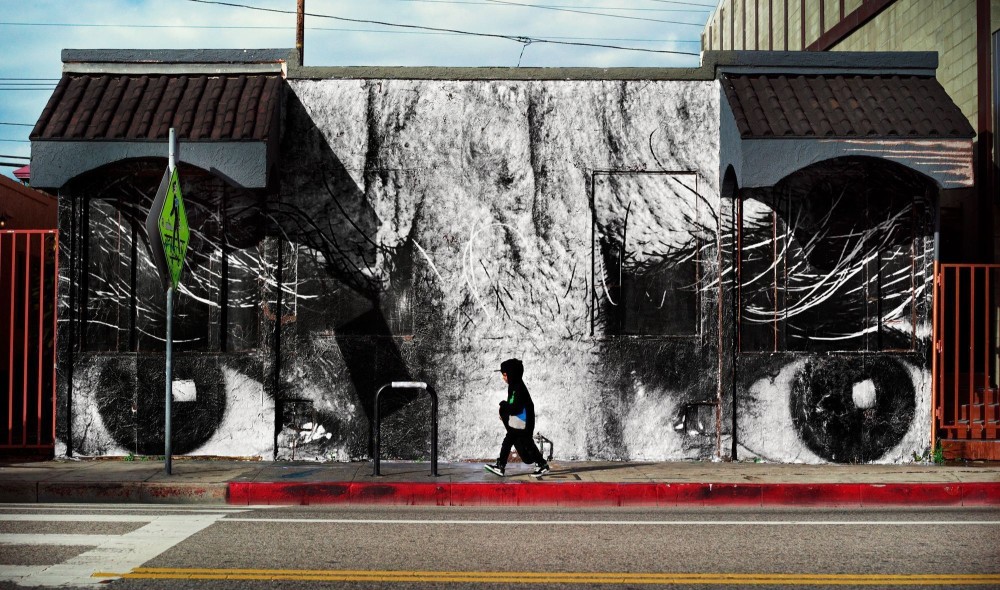
This exhibition brings together four bodies of work that JR created across California: in San Francisco, Los Angeles, Tehachapi, and along the U.S.–Mexico border near Tecate. Since 2011, he has repeatedly returned to the state, installing large-scale photographic interventions across its varied terrains, from the facades of buildings to prison yards and border infrastructure. In each instance his work turns built environments into places of encounter, empathy, and shared understanding. California, long imagined as the western edge of the continent, here becomes a shifting horizon, a place where questions of belonging, visibility, and possibility are continually coming in and out of focus.
JR’s practice operates at massive scale in both its scope and presentation, yet it often begins with individual encounters, captured through portraits of people and communities. These images of people coming from all walks of life are enlarged and sited in ways that render them visible, often in places where they can be made to feel invisible. The effect is not simply about scale, it is relational for both the viewer and the participant. Curiosity and recognition become a part of the encounter. A border wall becomes a site for gathering. A prison yard becomes a place of collective portraiture and collaborative creation. A city’s architecture is animated by the presence of those who inhabit it. In all these approaches, the use of perspective and its transformation of space allows for the conceptual collapse of distance, offering us a way to more clearly see the complexity of people and places.
In this way, the horizon in JR’s California projects is not a line we look toward but a social space we enter together. It is produced by participation, by what is removed, by who stands within the frame, and what is revealed that was once invisible. The works inhabit the structures of cities, prisons, and border zones, momentarily reorganizing how those spaces are experienced. They ask what becomes possible when the faraway is brought close, and when visibility itself becomes a shared act.