Maki Meets Mullican
In the late 1940s, Lee Mullican was making painted wooden sculptures that translated his striated language from the canvas into sculpture. This approach was developed during the active period of the Dynaton circle, the post-surrealist group of artists and thinkers formed by Mullican, Wolfgang Paalen, Gordon Onslow Ford, and Jacqueline Johnson. Mullican recalled that the name Tactile Ecstatics came about during a birthday party for Onslow Ford when the group was discussing what to call the new body of work, with Paalen saying, “you just can’t say wooden constructions.”[1] After Onslow Ford jokingly suggested The Lovelies, Paalen offered: Tactile Ecstatics. As a name that joined surface and sensation, Mullican decided that is what they would be called, describing their tactility as “all of these kind of spines sticking out on them,” while ecstatic belonged to Paalen’s verbal play, locating psychic states in material form.
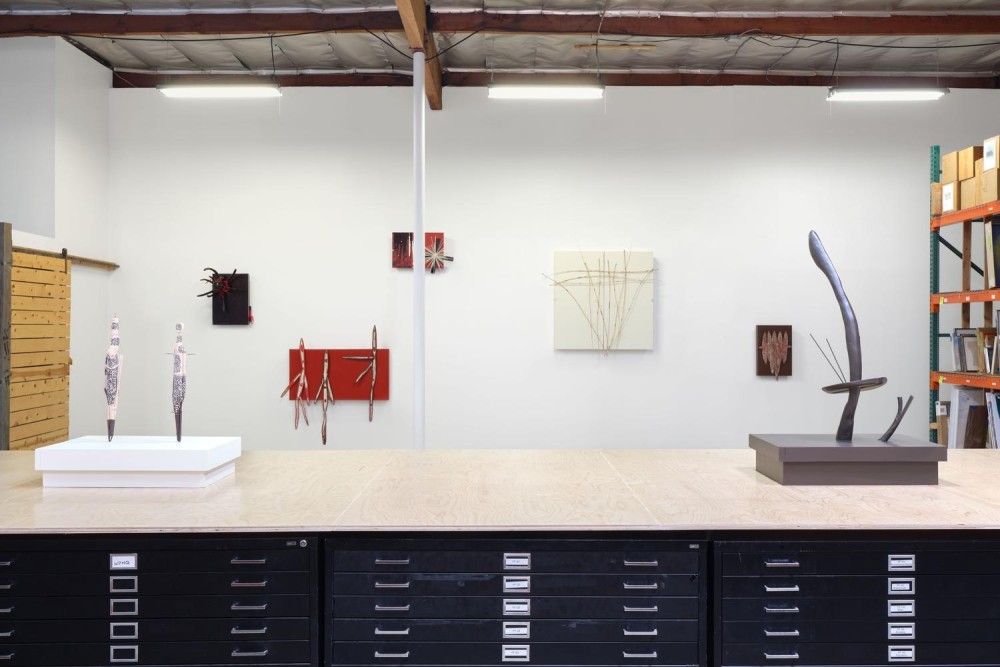
Mullican described the Tactile Ecstatics as, “attenuated images that stepped out of my canvases like ritual objects,” continuing, “I loved the whole idea of the surrealist sense of making an object.” He connected this impulse to traditions that expanded the category of modern sculpture such as Navajo sand paintings, Saltillo blankets, and Giacometti’s Palace at 4 a.m. Tactile Ecstatics drew from this lineage of objects whose power resided in “open air” and “open space”. Neither sealed volume nor flat image, but a structure of relations. Maki Meets Mullican stages this early body of work in collaboration with Adrienne Maki, whose sculptures reflect Mullican’s use of form and abstraction in an enigmatic meeting of minds. Maki’s box forms stage Mullican’s objects through their shared language of wood, color, animacy, and ritual. Informed by Japanese tea boxes, which historically served as inherited vessels for storage, travel, and ceremony, Maki’s work suggests containment, mobility, and interiority. When in dialogue with the explosive physicality of Mullican’s Tactile Ecstatics, the boxes serve as both support structure and conceptual proposition.
This reciprocal dialogue gives the exhibition its central framework. Mullican’s work expanding outward from painting into objecthood and Maki’s work grounded in enclosure and display. Throughout, wood is the material basis, embracing marks, joints, and ties to suggest the merging of plant life and crafted objects, the ceremonial and the domestic. Maki’s radial forms extend formal composition into a radical aliveness that unifies Mullican’s postwar search for sensation, spirit, and open space. Maki was drawn to the Dynaton as a moment when the foundations of modern painting were being tested and pushed beyond the picture plane, part of a broader effort to give material form to unseen forces, inner life, and expanded perception, where Mullican’s Tactile Ecstatics emerged directly. Together, their works co-create an exchange and extension as Maki reconsiders Mullican’s early body of work with the spatial ambition that first brought them into being.
[1] All quotes from: Lee Mullican, interview by Paul Karlstrom, May 22, 1992–March 4, 1993, transcript, Archives of American Art, Smithsonian Institution.