John Baldessari: Sculptures
John Baldessari is celebrated for his brilliant visual experiments with language, photography, and painting. Less explored is the artist’s creative use of three-dimensional space, whether by deploying patterned wallpapers, working in bas-relief, or creating captivating sculptures and installations. Monika Sprüth and Philomene Magers are pleased to present an exhibition at the Los Angeles gallery devoted to the sculptural impulse in Baldessari’s work, bringing projects together for the first time that illustrate his dramatic and often humorous manipulations of space and scale. Already in the 1980s, the artist expanded the physical bounds of his two-dimensional practice with his composite photoworks, in which multiple framed elements spread imagery in configurations across the gallery walls. In the mid-1990s, while producing bas-relief paper prints with the LA print workshop Mixografia, Baldessari remarked:
“Sculpture has always scared me. Face your fears. For me sculpture’s the final frontier. I’ve never done it. I’m just trying to edge into it backwards.” –John Baldessari
In 1997–98, he produced a series of colorful wallpapers imprinted with idiosyncratic objects, including Wallpaper for RMS W VU (Ear/Pretzel – Pink), and hung large, unique black-and-white photographs of lamps and plants on top of them. Recreated here for the first time, this pairing extended Baldessari’s play with language and form across the gallery walls, as well as generated optical effects of depth and recession.
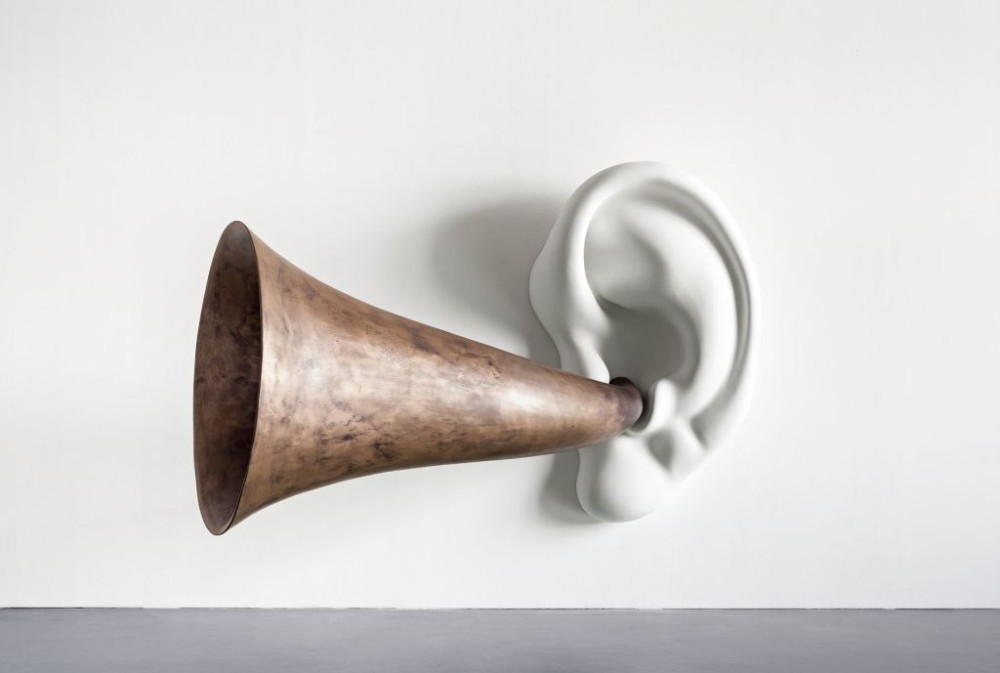
By the 2000s, the artist had moved headlong into working three-dimensionally. The exhibition includes some of his first sculptures, including Beethoven's Trumpet (with Ear) Opus #127, 130, 131, 132, 133, 135 (2007), an interactive work reproducing the eponymous composer’s listening device and a massive, oversized ear.
Inspired by a visit to Beethoven’s home in Bonn, Germany, the sculpture plays fragments of his late string quartets—considered some of his most radical pieces and created when he was fully deaf—when approached and triggered by a visitor’s voice. Not only does the work fill the exhibition space with embodied, sculptural form, it also charges it with sound.
Body parts were a quintessential feature throughout Baldessari’s œuvre, whether through their omission, as with his celebrated dots covering figures’ faces, or through their fragmentation. Shapely, sensory, and ultimately funny, they offered the artist a shorthand to examine how we experience the world and make meaning.
With Ear Sofa; and Nose Sconces with Flowers (2009), Baldessari isolated key parts of the face in order to recontextualize them both linguistically and spatially through absurdist juxtapositions. An olfactory organ is turned upside-down as a vessel for flowers; an ear is transformed into an unusual resting spot.
“Eyes and lips were pretty well done by Magritte, Man Ray and so on, but for some reason noses and ears and other anatomical parts haven’t been addressed so much and I thought, well, a lot of work to be done there.” –John Baldessari
In the major installation Brain/Cloud (Two Views): with Palm Tree and Seascapes, also from 2009, a massive white brain sculpture emerges from a plane of bright blue. Stretching across an adjacent wall is a serene seascape with one lone palm tree, its static, photographic flatness offering a counterpoint to the bulbous form nearby.
The polyurethane brain, pillowy and surrounded by azure skies, morphs visually into a cloud, conjuring more wordplay and figures of speech from “brain fog” to “head in the clouds.”
“I like banal images and I can’t think of anything more banal than a palm tree and an ocean.” –John Baldessari
Meanwhile, an image of the viewer, captured by a closed-circuit television camera, appears on the opposite wall and calls attention to the experience of viewing and being viewed. Baldessari’s sculptural tableaux encourage viewers to move physically, and intellectually, around their different parts and wholes, using simple spatial maneuvers to generate complex interpretive chain reactions.
Keeping with the bodily themes, for the series Raised Eyebrows/Furrowed Foreheads (2008–09) Baldessari taps into the sensuality of the eye—the supposed window to the soul—and exploits the expressive, humorous nature of the eyebrow and forehead. Like many of his works, the series begins with found film stills and photographs, which the artist fragments and manipulates. Using an array of vivid colors and levels of bas-relief, Baldessari accentuates the lines and creases of various faces, as well as their emotional charge.
In the 2010s, the final decade of his life, Baldessari embarked on a group of freestanding sculptures that brought his work fully into three dimensions. Fabricated from painted polyurethane and metal, among other materials, these works present realistic depictions of animals and objects that nonetheless traffic in the artist’s characteristic wittiness and irreverence.
Camel (Albino) Contemplating Needle (Large) (2013) is installed outside, greeting gallery visitors with its cool, white fiberglass skin, piercing blue eyes, and the metallic sheen of its oversized needle. Fake Carrot (2015) is suspended from the ceiling like a comical pendulum, and the exaggerated height of Penguin (2018) mimics the artist’s own unusually large stature.
More than just visually appealing, these works give physical form to the verbal, visual and aesthetic strategies that Baldessari explored for decades in a range of mediums. They engage us physically while disrupting how we view and understand images and objects, leaving a visceral impression that also revels in drama and delight.
John Baldessari (1931–2020) was a pioneer of American conceptual art. Through his rejection of traditional notions and boundaries, and his expansion of our understanding of what art can be, he became one of the best-known artists of our time. Baldessari was based in Los Angeles and profoundly impacted several generations of visual artists—from David Salle and Jack Goldstein to Cindy Sherman and Barbara Kruger. He has been associated with the gallery since 1995.