Betty Lane
Marc Selwyn Fine Art, in partnership with Almost Forgotten Women Artists, an initiative of the Cameron Parsons Foundation, is pleased to announce Betty Lane, the gallery’s first exhibition with the late American artist. Bringing together eight paintings from 1929 to 1947, the presentation offers a focused look at her diverse practice.
Born in Washington, D.C. in 1907, Lane began her studies at the Corcoran School of Art before continuing at the Massachusetts Normal Art School (now Massachusetts College of Art). In 1928, she traveled to Paris to study under André L’Hote. Lane developed a distinctive visual language defined by clarity of structure, sensitivity to color, and a quiet but persistent emotional charge. Her paintings are marked by a sense of compositional restraint that gives way to an underlying intensity—an effect that lends even her most pared-down images a lasting presence.
In Untitled (Provençal Landscape), c. 1929, painted around her studies in Paris, Lane organizes the landscape into interlocking planes of muted greens, ochres, and blue-grays, revealing the enduring influence of André L’Hote’s structural approach to composition — an approach that would remain central to her work. The painting balances a modernist sense of order with a lyrical sensitivity to atmosphere, transforming the rural scene into something both observed and imaginatively reconstructed.
In Rye, 1939, Lane distills an agricultural landscape into bold graphic forms and simplified geometry, using stark contrasts of black, white, and earthen tones to heighten the painting’s rhythmic composition. Though rooted in an identifiable rural setting, the work approaches abstraction through its flattened space and sculptural treatment of architecture, fences, and wagon wheels.
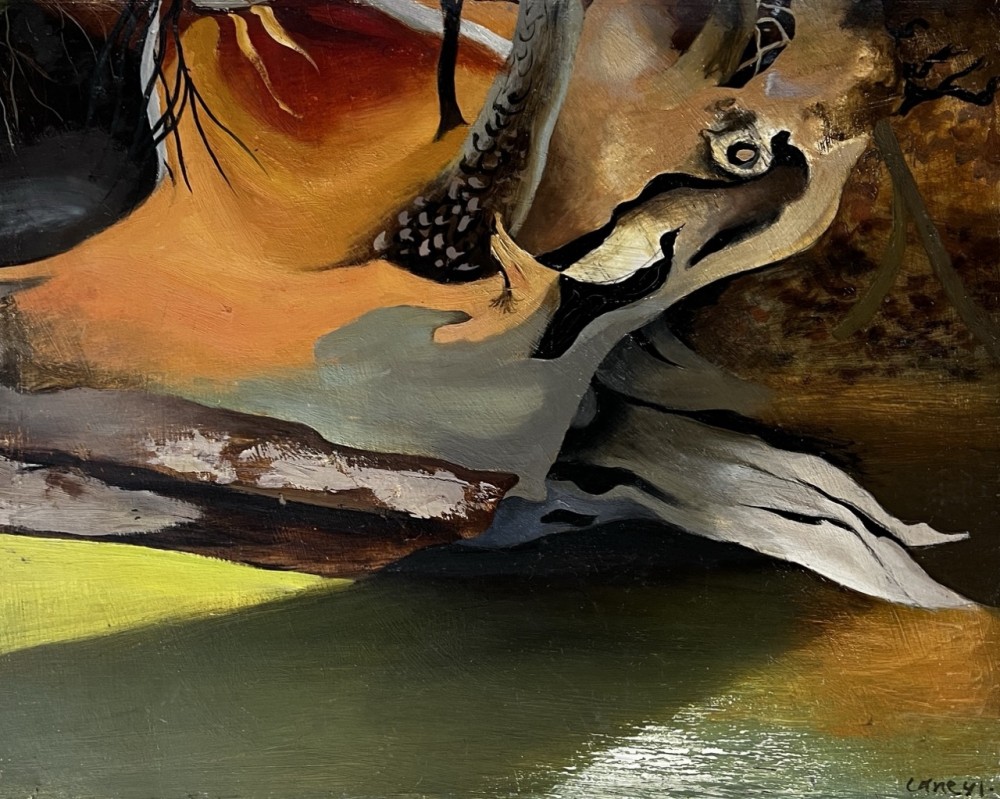
Lane’s practice absorbed a wide range of influences while maintaining a singular and personal vision. The lessons she drew from L’Hote, to pare away the inessential and emphasize the underlying structure of a subject, earned the early admiration of Duncan Phillips and Henri Matisse. She later incorporated the biomorphic vocabulary of Arp and Miró, along with subtle Surrealist inflections that attracted the attention of André Breton. Untitled (A Tree in the Forest), 1941, takes on this more expressive and intuitive quality. Swirling organic forms, deep umber and orange passages, and fluid contours create a dreamlike spatial tension, suggesting a landscape filtered as much through memory and emotion as direct observation.
In the early 1940s, Lane’s embrace of folk-art and planar pictorial devices brought a renewed vitality and distinctive character to her work in New York. In Dragon Rouge, 1944, Lane turns her eye to a riverboat, rendering its hull and smokestacks into bold planes set against muted passages of water and land. The painting exemplifies the graphic clarity of her mature work and reflects a sensibility informed by American folk and so-called "primitive" painting.
Stonybook, 1947, transposes Lane’s planar discipline onto a small American street corner. A mansard-roofed building, a striped awning, and a stark bare bare tree are simplified to delineated geometries and a restrained palette. The modest storefront, anchored by a hand-lettered Coca-Cola sign, becomes the occasion for a quietly observed study of place in which simplification yields both elegance and an undertone of stillness.
Curator Jeremy Tessmer writes, “Her paintings of the later 30s and 40s, in particular, feature the best of American modernism: vigor, sincerity and a culturally familiar reverence for the natural world.” Working within the constraints of mid-century expectations placed on women, Lane balanced her artistic practice with domestic responsibilities, often producing works on a modest scale and under limited conditions. Despite these challenges, she maintained a lifelong commitment to painting, creating a substantial and varied body of work across oil, watercolor, drawing, and printmaking.
In 1931, she had her first gallery exhibition with Duncan Phillips at the Phillips Memorial Gallery, now The Phillips Collection. Lane’s work is held in major public collections, including the Cape Cod Museum of Art, Dennis, MA; The Metropolitan Museum of Art, New York; the National Museum of Women in the Arts, Washington, D.C.; and The Phillips Collection, Washington, D.C. She passed away on March 24, 1996, at the age of eighty-nine.
Almost Forgotten Women Artists (almostforgottenwomenartists.org), an initiative of the Cameron Parsons Foundation, is dedicated to discovering and spotlighting influential 20th century women artists whose contributions have largely been obscured and overlooked. AFWA believes in the importance of recognizing their artwork and bringing to light their unique stories.