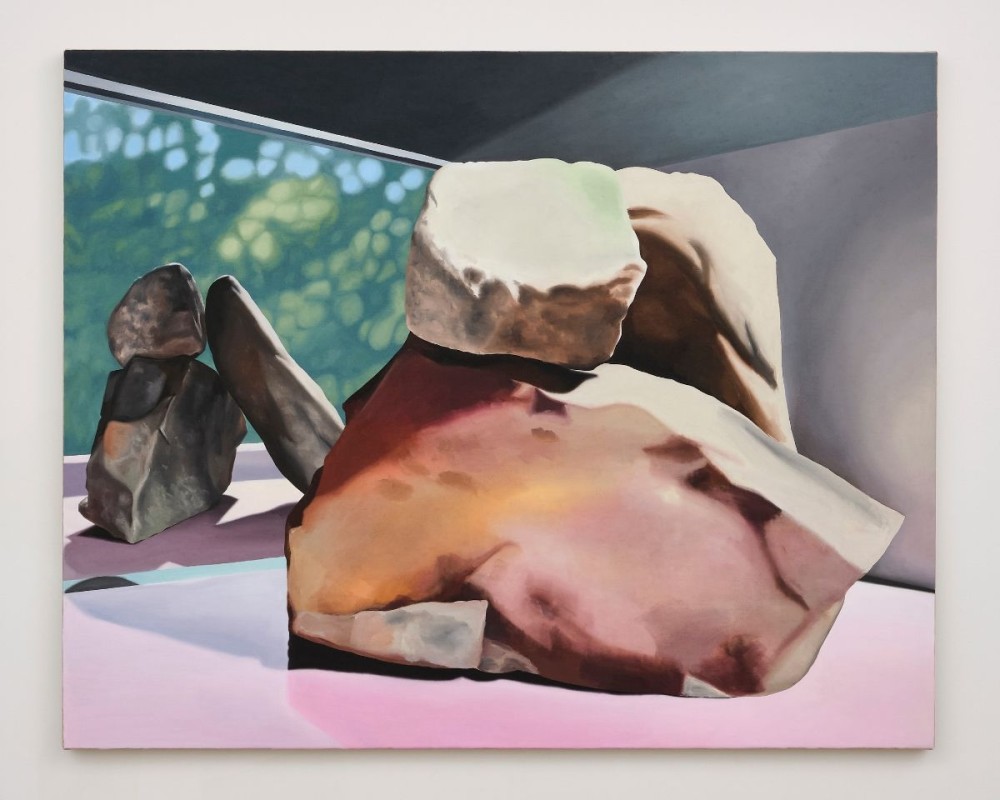
Secondary Source: Madeline Ludwig-Leone
Painter Madeline Ludwig-Leone presents Secondary Source, a new body of work that investigates how the natural world is framed, translated, and ultimately controlled through systems of perception and representation. Drawing from traditions of Western landscape painting while quietly destabilizing them, Ludwig-Leone situates fragments of nature within constructed interiors—window panes, floor planes, and beams—where landscape becomes something staged rather than experienced.
A 2024 graduate of ArtCenter College of Design, Ludwig-Leone approaches painting as an inquiry into how desire and ideology shape vision. Her compositions reference the Hudson River School and artists such as Thomas Cole, yet instead of sublime wilderness, viewers encounter model trees, arranged stones, open books, and sharply defined shadows. These elements form what the artist describes as “interior landscapes”—studio-bound scenes that expose the distance between lived environments and their romanticized cultural images.
Shadows act as the series’ central force. Repeated silhouettes stretch across flattened planes, suggesting solid three-dimensional forms while remaining visibly artificial. In Ludwig-Leone’s painted world, it is perpetually just past noon, a suspended hour of crisp light and elongated shadow. The effect recalls Dutch painting traditions and memento mori symbolism, though here shadows replace skulls, becoming quiet markers of transience, mediation, and absence. What first appears observational reveals itself as carefully staged, toggling between the incidental and the constructed.
The work also reflects on still life painting’s historical ties to colonial collecting and classification. By presenting books, rocks, and botanical signifiers as props rather than specimens, Ludwig-Leone critiques the seductive visual language through which Western art has long framed nature. Several paintings feature books written by her grandfather, a psychiatrist, whose titles—The Importance of Lying and The Price of Greatness—introduce themes of power, omission, aging, and memory. These personal references sit alongside boulders and studio objects, collapsing temporal scales from familial history to deep geological time.
Rendered in a deliberately spare visual vocabulary—hard edges, flat planes, and the conspicuous absence of living figures—Secondary Source positions mediation itself as subject. The paintings ask how artists filter their surroundings, how landscapes become projections of aspiration or control, and how representation reveals as much about the observer as the observed. The result is a quietly uncanny series that invites viewers to look askance: not at nature as it is, but at the layered systems through which it is seen.
-Angella d'Avignon