Hilary Pecis: Love Letters
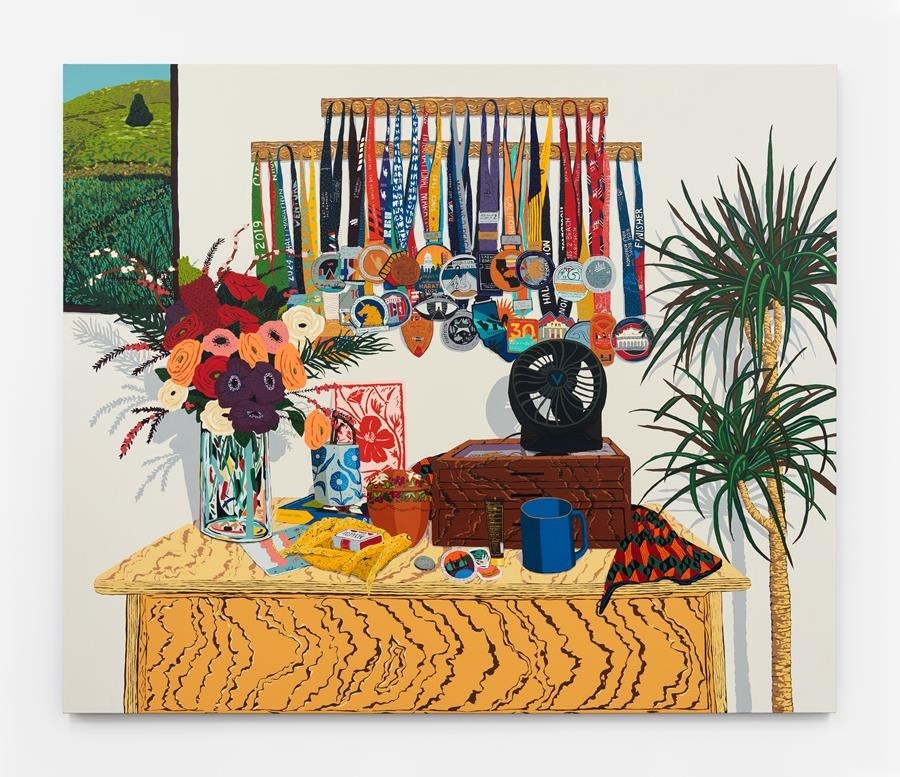
Like counterarguments against nihilism, the artworks in Love Letters distill everyday sites of connection into a visual language that itself feels like sustenance. Throughout the exhibition, Pecis’s vivid odes of affinity refer to people, places, and activities of particular significance. Depictions of the quotidian hang beside representations of personal milestones: the window of a friend’s art studio; the idiosyncratic signage of a Bay Area yacht club; a display of medals commemorating the dozens of races run by the artist, who likens the endurance sport to painting. Pecis is best known for creating hyper-saturated still lifes, lived-in interiors, and unmistakably Californian landscapes that conjure the Los Angeles region as an intimate setting for dailiness. The works in Love Letters traffic fluidly in these typologies while also expanding their boundaries, presenting an array of subjects united by the mysterious élan of affection.
In keeping with the diaristic nature of her work, Pecis’s paintings originate in quick snapshots she frequently takes of scenes and views that catch her eye. As photographs become paintings, memory and intuition come to guide her process: visual noise is removed or replaced, colors are changed or heightened, and perspective is regularly reimagined. The idea for Love Letters originated with the painting Backpackers, based on a photograph Pecis took more than fifteen years ago commemorating a trek up Mt. Shasta with her father, who named Pecis after the famed mountaineer Sir Edmund Hillary. Here, two bulging packs, ready to be hefted on, read as a single still from a larger narrative—the story of an outing as well as an ongoing familial relationship. Throughout the gallery, objects and environments suggest the spontaneous way the material world gives form to experience. Pecis’s paintings rarely include figures directly, which is not to say that her paintings are free of people. The human traces that mark her mise en scénes are the paraphernalia of life itself—a hat set down, a crumpled napkin, a chair awaiting a sitter—whose players seem to have stepped out only momentarily.
The works in Love Letters exemplify Pecis’s omnivorous approach to composition, especially her proclivity for corners, intersections, and angled vantage points. In Lily’s Backyard, a scene indebted to Matisse’s 1912 still life Goldfish, becomes an opportunity for spatial and chromatic play. The leafy density in the composition’s upper half is at once organic and graphic, somewhere between actual flora and floral patterning, while the lines of the brickwork, table legs, and slatted chairs create an exuberant layering of fields. Pecis’s carefully-delineated patterns, along with the uniform opacity of her hues, allow her paintings to carry more information than what the eye typically takes in—or the brain consciously registers. When a Silverlake hillside ascends the canvas, for example, even the trees and facades in the distance push toward the surface of the canvas—a signature effect the artist achieves by applying the same pure color to foreground as well as background shapes.
That the natural and the synthetic comingle in every one of Pecis’s canvases not only presents an accurate reflection of contemporary life, it also allows the artist to render and intermix a dazzling spectrum of matter. The singular, tabletop tableaux recognizable across Pecis’s oeuvre capture this visual dialogue between the organic and the human-made on a familiar scale. In Studio Lunch, the abundant meal strewed across the table gives way to the hands and torsos of two diners, with others suggested. Pecis explains that, in the multiunit building in which she works, she and the other artists habitually gather for lunch and celebrations. Here, the rare choice to include the figure emphasizes the import the artist finds in the communal nature of these gatherings: a painting of a meal becomes a portrait of the close-to-home places where we find support and friendship. By a similar logic, Corner depicts the artist’s living room, with her dog Tina at the center, as a place of refuge and interconnectedness. Beauty and loved ones quite literally serve to insulate a private interior from a public exterior by way of shelves packed with plants, ceramics, artist monographs, and family photos.
As a missive, a love letter implies an author’s desire to bridge a distance, whether of days, years, or miles, between herself and the beloved. Time, and the simple fact of its passage, is everywhere in Pecis’s display. Rich in detail, Pam’s Studio memorializes the corner view of painter Pam Jordan’s studio after the artist moved spaces, while the small image of a birthday cake is also an annual clock—a symbol of another year of existence, and deliciously ephemeral. Throughout Love Letters, we’re reminded that painting—especially the attention required by depiction—is a means of rescuing from obscurity what might otherwise be lost, forgotten, or taken for granted. In this sense, Pecis’s images read as sustained gestures of gratitude for what has been, and what is.
Hilary Pecis (b. 1979, Fullerton, California) has been the subject of solo exhibitions at TAG Art Museum, Qingdao, China (2023); Rockefeller Center, New York (2021); Timothy Taylor, London (2021); Spurs Gallery, Beijing (2020); Rachel Uffner Gallery, New York (2020); and Crisp-Ellert Art Museum, Flagler College, St. Augustine, Florida (2019). Recent group exhibitions include Dine In, Buffalo AKG Art Museum, NY; Day for Night: New American Realism, Palazzo Barberini, organized by the Aïshti Foundation, Rome (2024); The Interior Life: Recent Acquisitions, National Gallery of Art, Washington, D.C. (2023); 13 Women: Variation I, Orange County Museum of Art, Costa Mesa, California (2022–2023); Present Generations: Creating the Scantland Collection of the Columbus Museum of Art, Columbus Museum of Art, Ohio (2021); FEEDBACK, The School at Jack Shainman Gallery, Kinderhook, New York (2021); L.A.: Views, Maki Gallery, Tokyo (2020); High Voltage, The Nassima-Landau Project, Tel Aviv, Israel (2020); and (Nothing but) Flowers, Karma, New York (2020). Her work is in the permanent collections of institutions including the Museum of Fine Arts, Boston, Massachusetts; San Francsico Museum of Modern Art, California; National Gallery of Art, Washington, D.C.; Los Angeles County Museum of Art, California; Columbus Museum of Art, Ohio; Palm Springs Art Museum, California; and Aïshti Foundation, Beirut. Pecis lives and works in Los Angeles.